Miracle of Light — Hanukkah
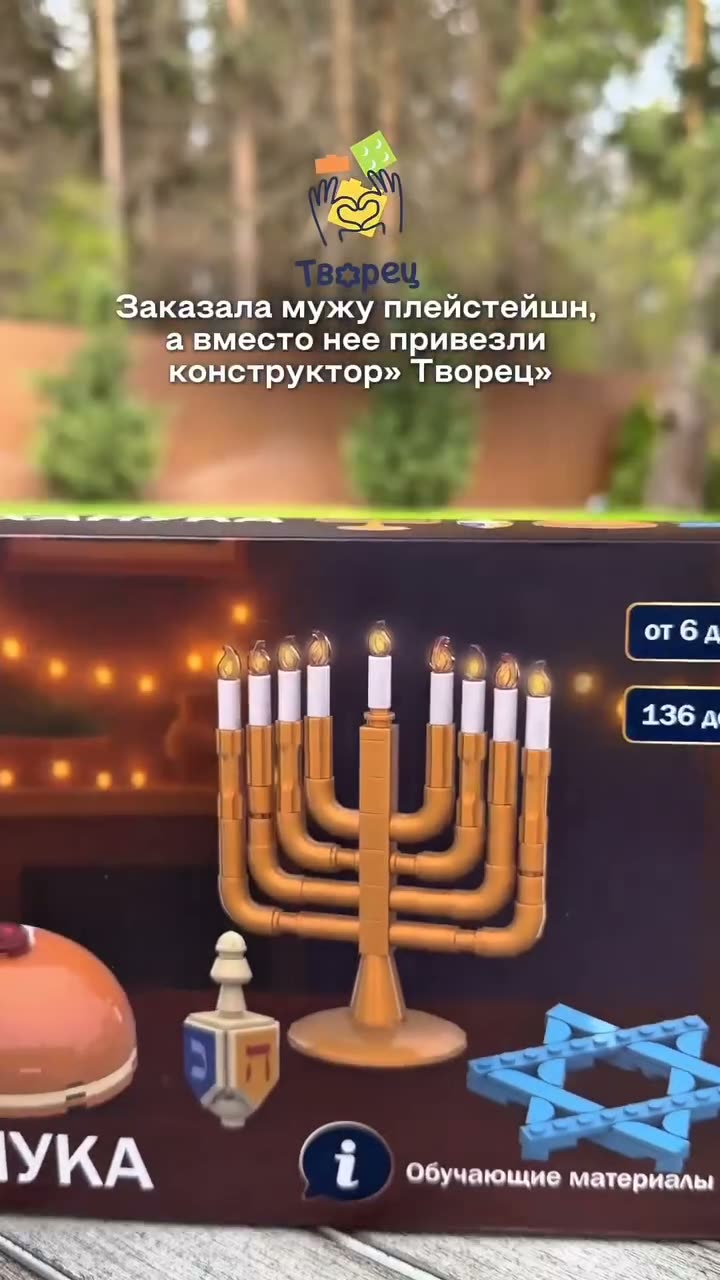
A hanukkiah you build yourself, a dreidel that really spins, a Star of David and a sufganiyah — everything a Hanukkah evening is made of. A small set that turns into the story of the miracle of light.
- 136 pieces
- ages 6 to 120
- instructions with notes on the tradition
VAT included · Free home delivery · 3–5 business days
Not suitable for children under 3 years. Choking hazard — contains small parts.
How it goes
From the box to a lit hanukkiah
A small set — one evening. The star, the sufganiyah, the dreidel and the hanukkiah are built one after another, each with its own story.
- 1
Unbox
Bags of pieces and a booklet with not just diagrams but the story of the miracle of light.
- 2
Build the star
The Star of David comes together from blue pieces — the first finished part of the set.
- 3
Sufganiyah done
A doughnut fried in oil — and a reminder of why it is eaten on Hanukkah.
What's inside
Symbols of the holiday
Hanukkiah
The nine-branched lamp: eight candles, one for each night of the holiday, and the shamash they are lit from.
Dreidel
A spinning top that really spins. Its four sides carry the letters נ ג ה פ — “Nes gadol haya po”, “a great miracle happened here”. Outside Israel the last letter is ש, “there”.
Star of David
Built separately from its own pieces — and becomes a decoration for the holiday table.
Sufganiyah
A doughnut fried in oil — a reminder of the jar of oil that lasted eight days.
Photos
The set up close
Tradition
Eight evenings of light
Hanukkah commemorates the rededication of the Temple after the Maccabees' victory. Only one day's worth of oil was found for the Temple lamp, yet it burned for eight. Ever since, one more candle is lit in homes on each evening of the holiday — from one to eight.
The hanukkiah is placed by the window so the light can be seen from the street: a miracle is meant to be shown, not hidden. Children play dreidel, the family eats sufganiyot and latkes — anything fried in oil belongs to this holiday.
In the set, each of these symbols is built by hand. The instructions say not only where a piece goes but why it is there — so a child learns the story of the holiday without stopping the play.